Tactics · real screens from the game
The tactics board.
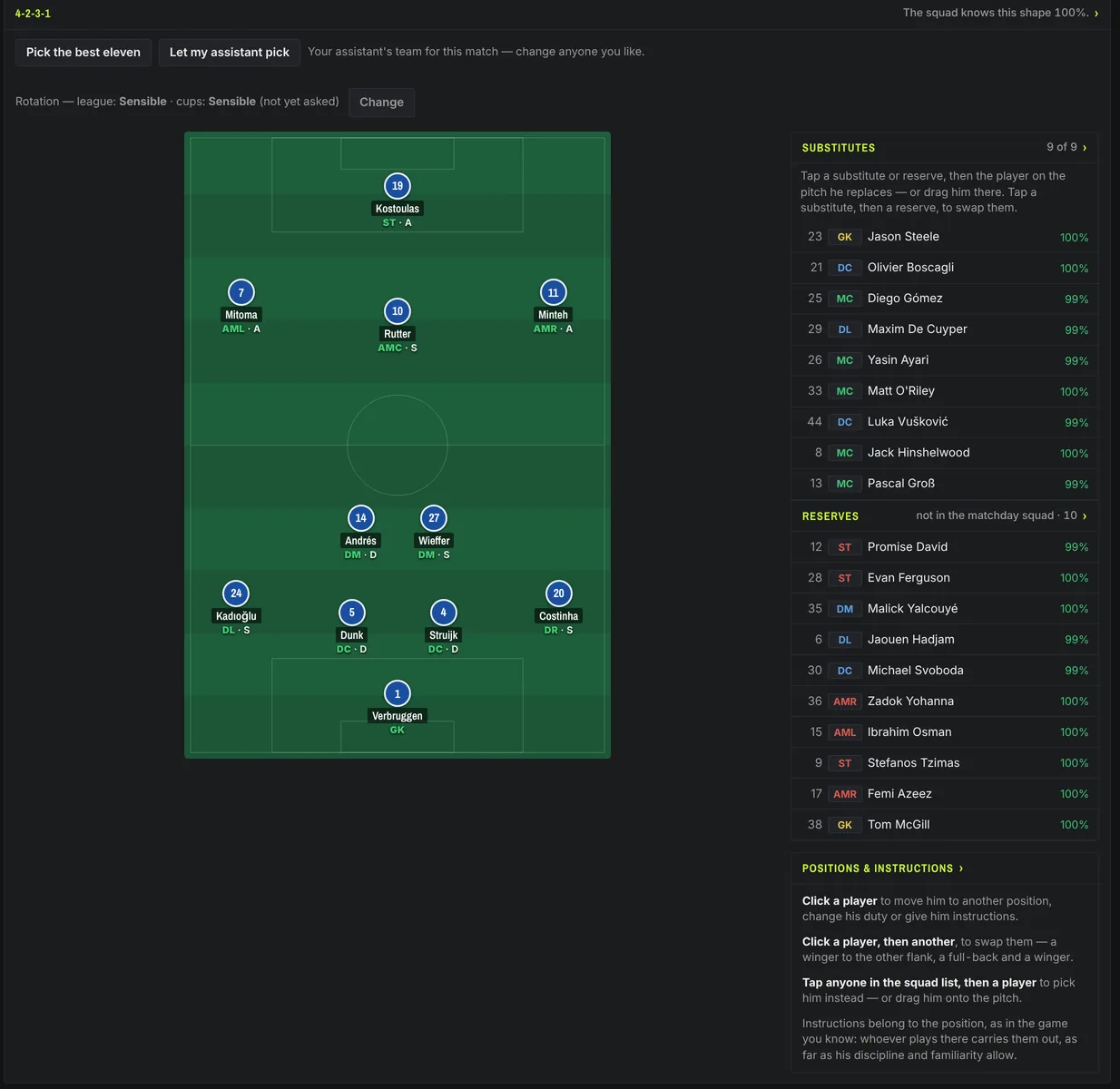
Pick a shape, set every role on the board, drill it in training and change it during the match. Your squad plays what you set, as well as they've learned it.
How it works
From the board to the pitch
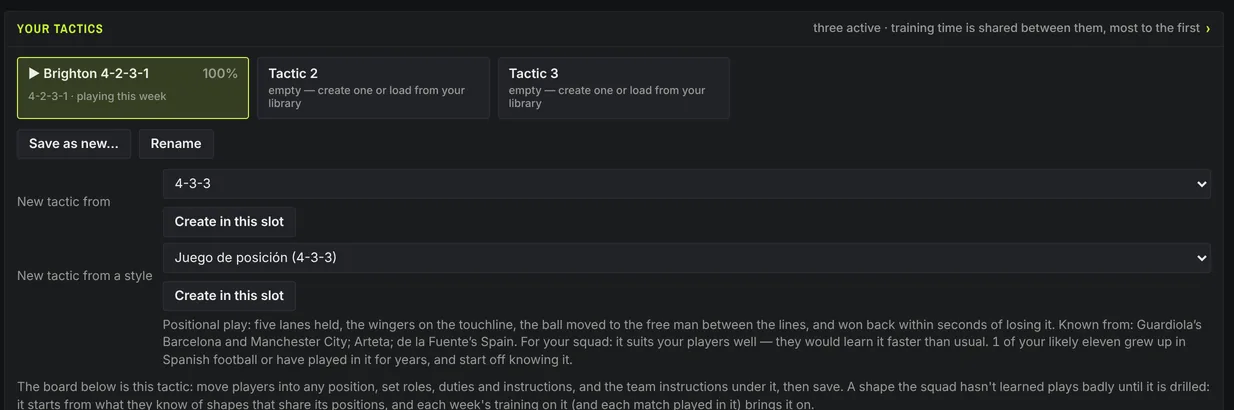
Pick a shape, or start from a style
Choose from 18 formations, or start from one of 20 playing styles, each with its shape, roles and team instructions set. You can keep three tactics ready, and training time is shared between them.
Set every position on the board
Tap a player to move him, change his role and duty, or give him instructions. 42 roles, from the sweeper keeper to the raumdeuter, each with attack, support or defend. Instructions belong to the position, so whoever plays there carries them out, as far as his discipline and familiarity allow.
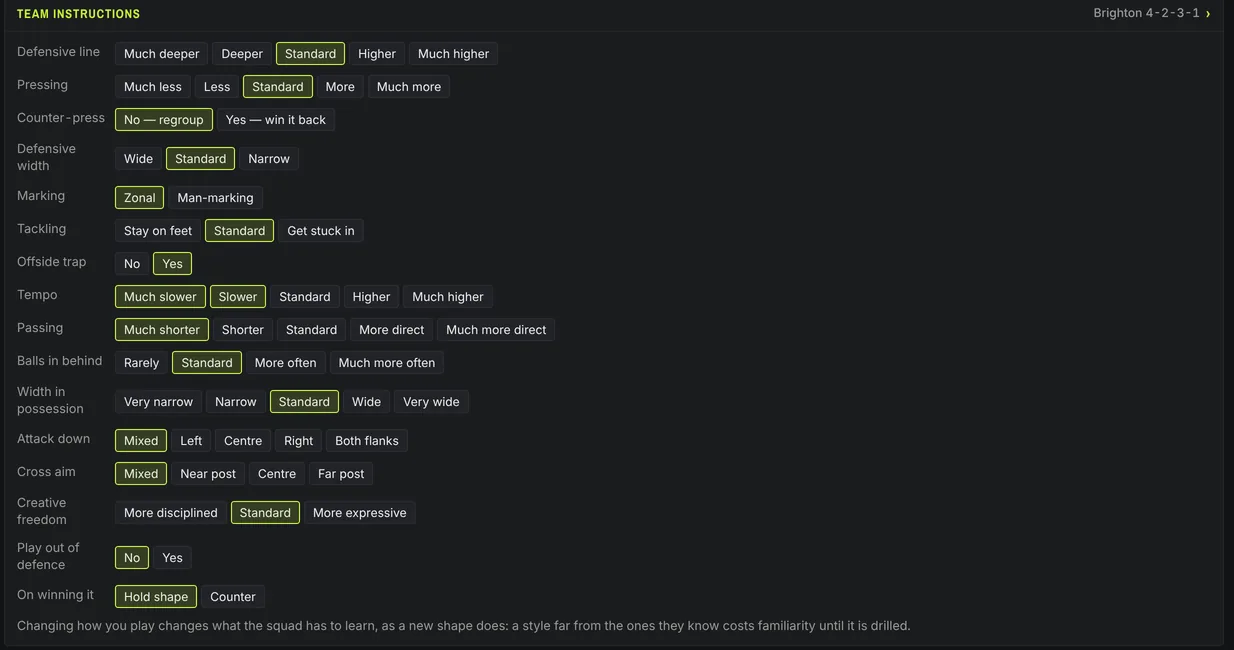
Tell the team how to play
16 team instructions: the defensive line, the press, the counter-press, marking, tempo, passing, width, where to attack, what to do on winning the ball, and more.
Drill it in training
A new plan is played badly until it's drilled. Players carry out less of it, lose their positions and pass to where teammates aren't. Every week's training, and every match played in it, brings it in.
Add patterns of play
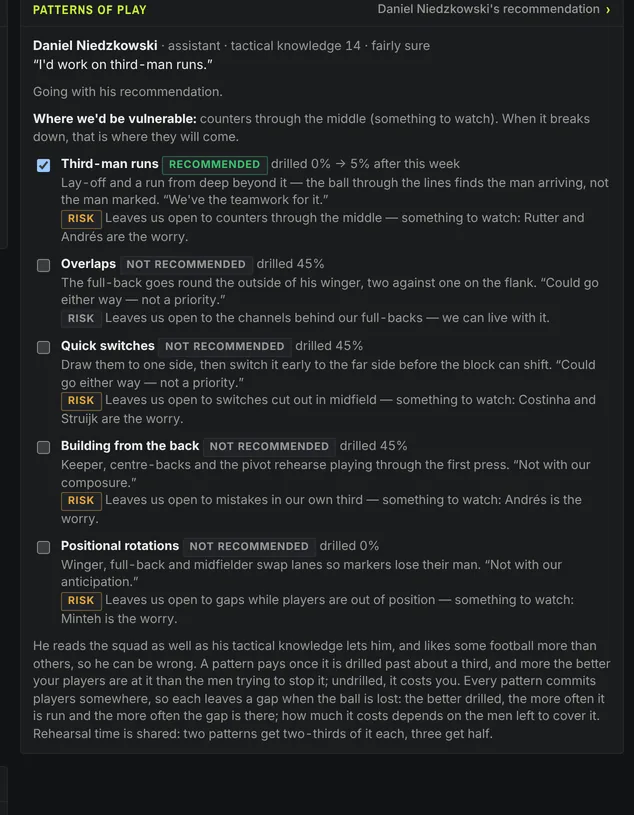
Third-man runs, overlaps, quick switches, building from the back and positional rotations. Your assistant recommends which suit your players, and tells you the gap each one leaves when it breaks down.
Set pieces, on their own board
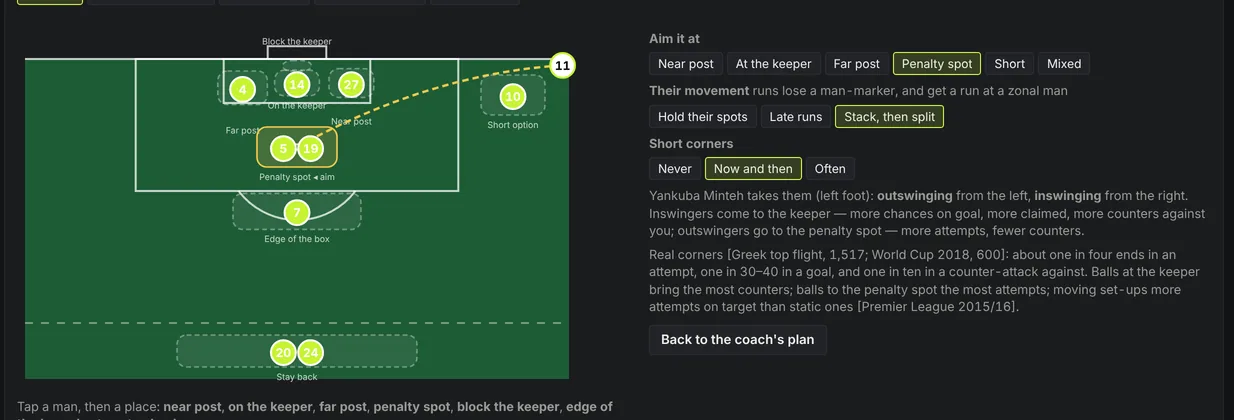
Pick your takers, then draw the routine: who goes near post, who blocks the keeper, who waits on the edge of the box. Corners, crossed free kicks, long throws, defending them and the counter.
Change it during the match
Your analyst flags what's happening. You make the change, the other manager sees it and answers after a delay, and the match plays out from there.
Team instructions
Tell them how to play
Every instruction changes what the match engine does with the ball and without it. Change too much at once and the squad has to learn it all again.
Patterns of play
Rehearsed moves, and the gaps they leave
Your assistant reads the squad and recommends the patterns that suit it, with the risk of each spelled out. Two patterns get two-thirds of the rehearsal time, three get half.
Set pieces
Draw the corner routine
Tap a man, then a place: near post, on the keeper, far post, penalty spot, the edge of the box. The better drilled the routine, the more often the taker finds his man.
Playing styles
20 ways to play, from 7 football cultures
Start a tactic from a style and its shape, roles and instructions are set for you. A squad learns a style faster if its players grew up with it, so tiki-taka comes easier to a side raised in Spain than one raised in Germany.
Spain
- Juego de posición4-3-3 · possessionPositional play: five lanes held, the wingers on the touchline, the ball moved to the free man between the lines, and won back within seconds of losing it.
- Tiki-taka4-3-3 · possessionShort, patient passing in tight triangles through a crowded middle, a false nine, and a swarming press the moment it is lost.
- Cholismo4-4-2 · defensiveA narrow, deep-lying 4-4-2 that shuts the middle, springs traps on the flanks, fights for every ball and breaks at speed.
Italy
- Catenaccio5-3-2 · defensiveMan-markers on their forwards, a libero sweeping behind them, the wing-backs deep — and the ball out quickly to the front two.
- Uomo contro uomo3-4-2-1 · pressMan-to-man all over the pitch: every opponent has a shadow, the centre-backs follow their men into midfield, and duels decide it.
- Sarriball4-3-3 · possessionQuick, vertical short passing — one or two touches, through a regista, overloading one flank and combining around the box.
- 3-5-2 with overlapping centre-backs3-5-2 · counterA back three whose outer centre-backs overlap, wing-backs high, a regista, two up front — compact without the ball, rotating with it.
Portugal
- Organised transitions4-2-3-1 · counterThe Portuguese school: a compact mid-block with a double pivot, rehearsed movements the moment the ball is won, and the switch to the free side.
- 3-4-3 with inside forwards3-4-3 · pressA back three that builds, wing-backs giving all the width, two narrow forwards in the half-spaces behind a striker, and a coordinated press.
- Intensity 4-4-24-4-2 · pressAggressive, front-foot football: a high 4-4-2 press, hard in the tackle, and straight at goal once it is won.
Germany
- Gegenpressing4-3-3 · pressWin it back high and at once, and attack the space the other side has just left.
- Vertical pressing 4-2-2-24-2-2-2 · pressNarrow and relentless: everything forward within seconds, two strikers and two inside forwards, and the press straight back on when it is lost.
Brazil
- Relationism4-2-3-1 · possessionPositions give way to relationships: players come to the ball, combine in close support on one side, and trust improvisation. The far side is left empty.
- Jogo bonito4-2-2-2 · possessionThe magic square: two holding midfielders, two free meias behind two forwards, full-backs as wingers, and the licence to dribble.
Norway
- Glimt 4-3-34-3-3 · pressA very high line and relentless press, full-backs overlapping, rotations between winger and eight, and quick combinations to the byline.
- Drillo4-5-1 · directZonal and direct: a disciplined 4-5-1, the ball forward early, the long diagonal to a tall man on the flank, and bodies arriving for the knock-down.
England
- Direct4-4-2 · directThe English tradition: early balls forward and down the flanks, crosses, and win the second ball.
Anywhere
- Possession, high line4-3-3 · possessionKeep the ball, squeeze them in, and press to get it back.
- Counter-attacking4-2-3-1 · counterSit off, win it, and go quickly into the space behind.
- Low block4-5-1 · defensiveDeep and narrow, nothing through the middle, and long when it is won.
Formations
18 shapes to start from
Every one is tested against the same opponents to check none is broken or unbeatable. The best one is the one your players can carry out.